
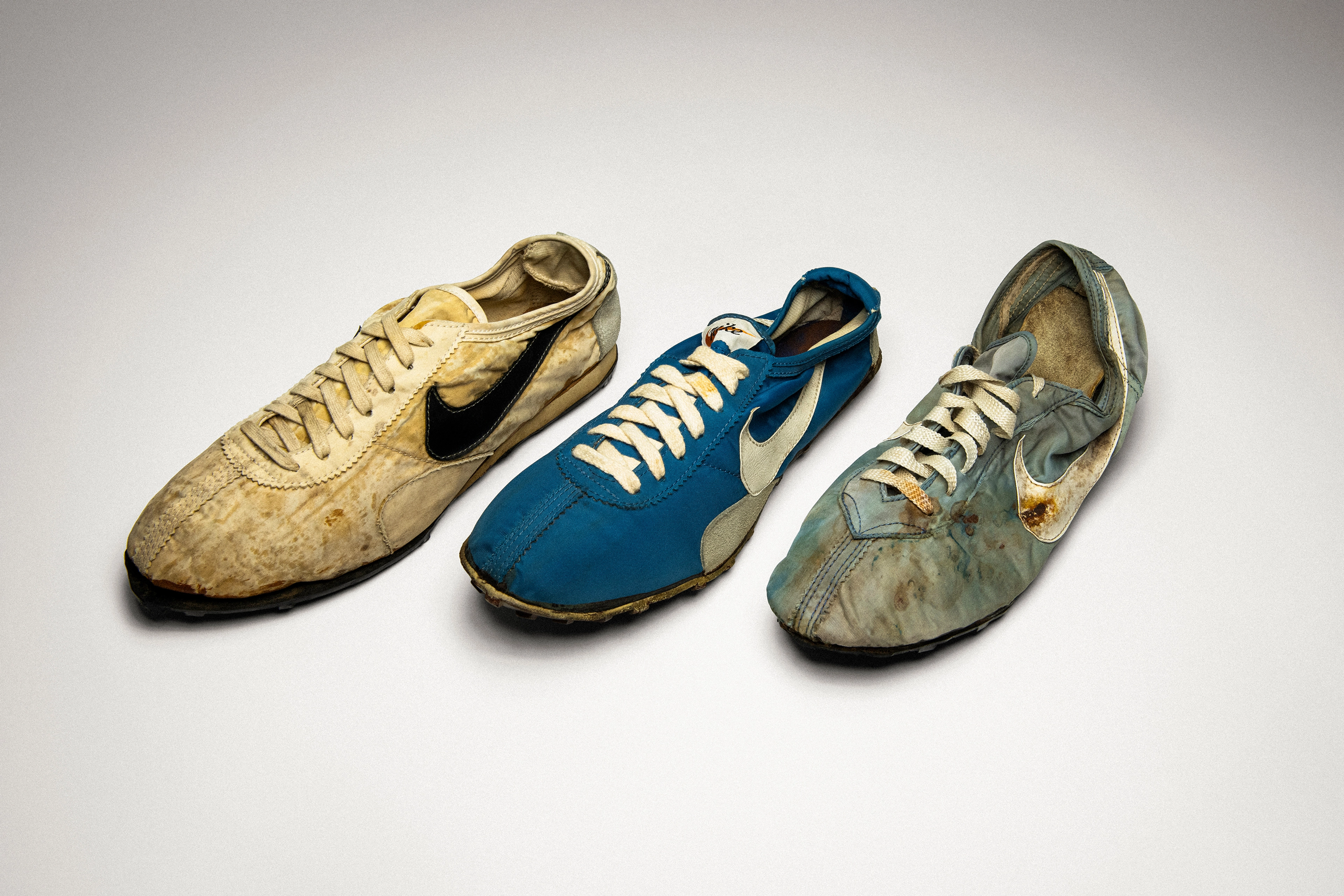
If there’s one sneaker that genuinely made history, it’s the Nike Moon Shoe. Long before raffles, resale charts, and collaboration culture took over, this was a silhouette born out of raw experimentation. Decades later, it still sits at the very foundation of everything Nike represents.
To really get why the Moon Shoe matters, you have to go back to the early 1970s. Nike wasn’t yet the global giant. It was a challenger brand built on innovation, led by co-founders Bill Bowerman and Phil Knight. Bowerman, in particular, wasn’t interested in aesthetics or hype. As a track and field coach, he cared about one thing: performance.
The origin story is now the stuff of legend. One morning in 1971, Bowerman looked at his waffle maker and saw potential. The grid pattern, he thought, could be translated into a sole that offered grip without the added weight of traditional running shoes. It sounds simple, but that idea would go on to change footwear forever. That experiment led directly to the creation of the Nike Moon Shoe and the destruction of the Bowerman family's waffle maker.

Designed for the 1972 U.S. Olympic Trials in Eugene, Oregon, the Moon Shoe wasn’t a commercial release. It was a prototype. Rough, handmade, and built with purpose. Only around 12 pairs were ever produced, each slightly different, each a test of Bowerman’s revolutionary waffle sole.
Aesthetically, it’s almost unrecognisable compared to modern sneakers. Lightweight nylon uppers, a minimal build, and that distinctive waffle outsole define the look. No branding overload, no gimmicks, just pure function. There was some storytelling, though. The name “Moon Shoe” itself comes from the outsole imprint, which resembled astronaut footprints on the moon. Fitting, given how groundbreaking it was.
For years, the Moon Shoe existed more as a founding myth than a reality. With so few pairs in circulation, it became one of sneaker culture’s most elusive pieces. That changed in 2019, when a pair went up for auction at Sotheby's, eventually selling for $437,500 to collector Miles Nadal. At the time, it became the most expensive sneaker ever sold, instantly cementing its legacy beyond just niche collector circles.
The Moon Shoe is where Nike’s obsession with innovation began to take shape. The waffle sole alone would go on to influence decades of performance design, becoming a core part of the brand’s DNA. Fast forward to today, and that same DNA is still being reinterpreted, just through a very different lens.

Take Nike’s ongoing collaborations with Simon Porte Jacquemus and his label Jacquemus. Their projects together have consistently tapped into Nike’s archive, blending minimalist high fashion with athletic heritage. After taking on ACG and Air Max, Jacquemus went back to the beginning in 2025, recontextualising the Moon Shoe’s sleek form to fit into today’s demand for low-profile torpedo shoes. 
And now, in 2026, the Moon Shoe story is entering a new chapter. Nike is bringing the silhouette back. Not just with more collabs, not as a one-off collectable, but as a considered GR reissue that bridges past and present. That means the classic waffle iron sole remains front and centre, and the upper stays lightweight, with a whole new range of colourways giving the shoe an extra layer of wearability. Meeting modern trends and returning to Nike’s roots all at once.
Check out the range of Nike Moon Shoes available on KLEKT